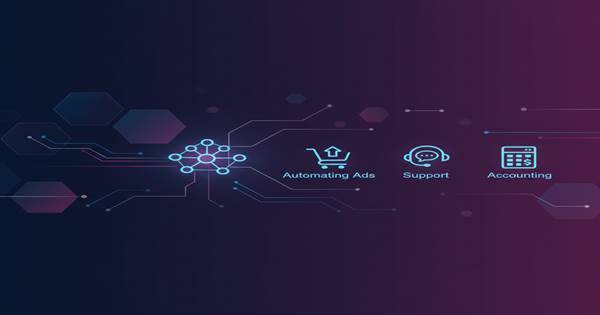
The digital marketplace is an ever-evolving beast, demanding constant innovation and efficiency from businesses. For e-commerce entrepreneurs, this translates into a relentless pursuit of optimization – from attracting customers to managing finances. The good news? Artificial intelligence is no longer a futuristic concept; it's a powerful, accessible tool that can revolutionize how e-commerce operates, streamlining critical functions like advertising, customer support, and accounting into a cohesive, automated ecosystem.
The E-Commerce Imperative: Why Automation is No Longer Optional
In today's hyper-competitive e-commerce landscape, standing still means falling behind. Customers expect instant gratification, personalized experiences, and seamless interactions. Businesses, in turn, are under pressure to reduce operational costs, increase conversion rates, and maximize profitability. This confluence of demands often leaves founders and teams stretched thin, juggling countless tasks and struggling to scale effectively.
This is where AI steps in as a game-changer. It offers the ability to automate repetitive, time-consuming tasks, freeing up human talent to focus on strategic initiatives, creative problem-solving, and building meaningful customer relationships. Think of AI not as a replacement for human ingenuity, but as an intelligent assistant, an army of virtual workers diligently handling the intricate details of your business. The concept of a virtual office, once a novelty, is now becoming a sophisticated hub powered by AI, where intelligent agents manage workflows and interactions with unprecedented efficiency.
AI-Powered Advertising: Precision Targeting and Campaign Optimization
The days of broad, untargeted advertising campaigns are long gone. E-commerce success hinges on reaching the right audience with the right message at the right time. AI excels in this domain, transforming advertising from an art into a science. By analyzing vast datasets, AI algorithms can identify subtle patterns in customer behavior, preferences, and purchasing habits that human marketers might miss. Platforms like AI Workers are leading this transformation.
Imagine an AI system that constantly monitors your website traffic, social media engagement, and past purchase data. This system can then segment your audience into highly specific groups, each with unique characteristics and interests. Based on these insights, the AI can dynamically generate personalized ad copy, select the most effective visuals, and even determine the optimal bidding strategies across various platforms. This isn't just about showing an ad; it's about delivering a highly relevant, compelling message that resonates deeply with the individual viewer.
Furthermore, AI can continuously optimize your campaigns in real-time. If an ad isn't performing well, the AI can automatically adjust its parameters – changing the target audience, tweaking the creative, or reallocating budget – to improve its effectiveness. This eliminates the need for constant manual monitoring and adjustments, saving countless hours and ensuring your ad spend is always working as hard as possible. The emergence of AI workers in advertising means that campaign managers can now delegate the granular, data-intensive tasks to intelligent agents, allowing them to focus on overarching strategy and creative direction.
Elevating Customer Support: Instantaneous, Personalized, and Proactive
Customer support is the backbone of any successful e-commerce business. Negative experiences can quickly lead to lost sales and damaged reputations. AI offers a powerful solution to enhance customer satisfaction, providing instant, 24/7 support that is both personalized and proactive. Chatbots, powered by natural language processing (NLP), are at the forefront of this revolution.
These intelligent virtual assistants can handle a wide range of customer inquiries, from answering frequently asked questions about product specifications and shipping policies to assisting with order tracking and basic troubleshooting. They can access your product catalog and order management system, providing accurate and up-to-date information instantly. This significantly reduces the workload on human support agents, allowing them to focus on more complex issues that require empathy, critical thinking, and human intervention.
Beyond reactive support, AI can enable proactive customer engagement. For instance, an AI system might identify a customer who has repeatedly viewed a particular product but hasn't made a purchase. It can then trigger a personalized email offering a discount or providing additional information to encourage conversion. Similarly, if a customer experiences a shipping delay, the AI can automatically send proactive updates, managing expectations and preventing frustration. This proactive approach builds trust and demonstrates a commitment to exceptional service, transforming potential pain points into opportunities for positive interaction. Imagine a virtual office where AI workers are constantly interacting with customers, solving problems, and anticipating needs before they even arise.
Streamlining Accounting and Financial Management: Accuracy and Efficiency
For many e-commerce entrepreneurs, accounting is a necessary evil – a time-consuming, often tedious task that takes away from core business activities. AI is transforming financial management, bringing unprecedented levels of accuracy, efficiency, and insight to the accounting process. From automated expense tracking to intelligent reconciliation, AI is simplifying what was once a complex and error-prone domain.
AI-powered accounting software can automatically categorize transactions, reconcile bank statements, and generate financial reports. By integrating with your e-commerce platform, it can track sales, returns, and inventory movements in real-time, providing an accurate picture of your financial health at any given moment. This eliminates manual data entry, reduces the risk of human error, and ensures that your financial records are always up-to-date and compliant. For example, Addy – the AI ads manager demonstrates exactly how this works in practice.
Furthermore, AI can go beyond basic bookkeeping to offer valuable financial insights. It can analyze spending patterns, identify areas for cost reduction, and even forecast future revenue based on historical data and market trends. Imagine an AI system that alerts you to potential cash flow issues before they become critical, or highlights opportunities for optimizing your pricing strategies. This level of financial intelligence empowers business owners to make more informed decisions, leading to greater profitability and sustainable growth. The concept of AI workers extends to the finance department, where intelligent agents meticulously manage ledgers and generate reports, offering a level of precision and speed previously unattainable.
Integrating AI: Building Your Intelligent E-Commerce Ecosystem
The true power of AI in e-commerce lies not just in automating individual functions, but in integrating these automated processes into a cohesive, intelligent ecosystem. Imagine a scenario where your AI-powered advertising campaigns generate new leads, which are then nurtured by your AI customer support system, leading to sales that are seamlessly recorded and analyzed by your AI accounting software. This creates a virtuous cycle of efficiency and growth.
To achieve this, businesses should look for AI solutions that offer integration capabilities or consider platforms that provide an all-in-one AI suite. The goal is to create a seamless flow of data between different departments, allowing AI agents to work together and share insights. This interconnectedness allows for a holistic view of your business, enabling more intelligent decision-making across the board. The virtual office, in this context, becomes a highly sophisticated, interconnected network of AI workers collaborating to drive business success.
Starting small is often the best approach. Identify the most pressing pain points in your e-commerce operations and begin by implementing AI solutions in those areas. Perhaps it's customer support first, or maybe optimizing your ad spend. As you gain experience and see the benefits, you can gradually expand your AI integration to other facets of your business. Prioritize solutions that offer scalability and flexibility, allowing them to evolve alongside your business needs.
Conclusion
The future of e-commerce is undeniably intertwined with artificial intelligence. By embracing AI to automate advertising, customer support, and accounting, businesses can unlock unprecedented levels of efficiency, accuracy, and personalization. This shift is not merely about adopting new technology; it's about fundamentally rethinking how businesses operate, empowering human talent, and creating a more resilient, responsive, and profitable enterprise. The virtual office, powered by a diligent army of AI workers, is no longer a distant dream but an accessible reality, ready to transform your e-commerce venture. The time to integrate AI into your e-commerce strategy is now, positioning your business for sustained success in an increasingly automated world.